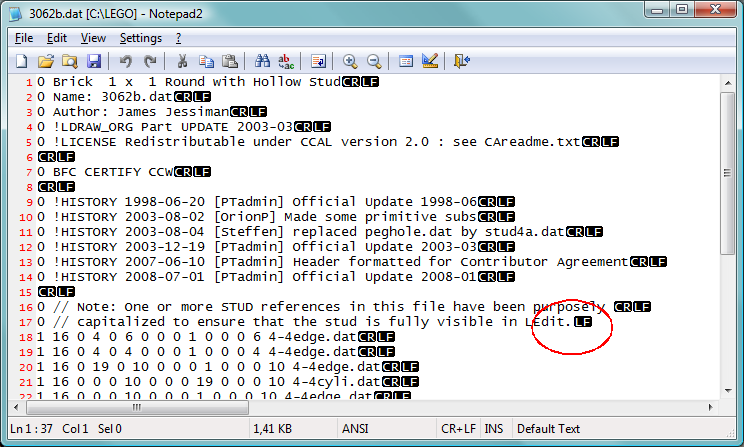
Text Editor For Mac Show Line Endings
EditPad Pro is a powerful text editor for Windows. You can edit all text files with EditPad Pro. Open text files saved on Linux, UNIX and Macintosh computers, or even text files from old DOS PCs or IBM mainframes. You’ll never have to worry about being unable to open a text file, and you’ll always be able to save your files in a format that people with less flexible text editors can read.
Many other text editors automatically convert each file you open to Unicode, and convert it back to the legacy encoding when saving. This reduces performance with large files. If the wrong encoding is used by the editor, or if the file had invalid characters, data corruption will occur.
Make the vi/vim text editor show or hide line numbers. Vim can display line numbers in the left margin: Press ESC key; At the: prompt type the following command to run on line numbers: set number; To turn off line numbering, type the following command at the: prompt set nonumber; Let us see all commands in detailed to display line number in vim. Is there a way to search for line endings, ¶, in ANY mac text editor so I can say, for instance append a www. Or @ symbol infront of 200 lines of domain names? Ex: john.com mary.com todd.com find / replace.comwww. www.john.com www.mary.com www.todd.com I can do it on a. The next time you save the file, its line endings will, all going well, be saved with UNIX-style line endings. You can check what format line endings you are currently editing in by looking in the status bar at the bottom of the window. Between the range box (a box containing Ln, Col and Sel entries) and the text encoding box (which will.
Plain Text Editor For Mac
EditPad Pro reads and edits files in their original encoding. This allows EditPad Pro to open huge files instantly. EditPad Pro preserves the compatibility of all files you edit with the legacy systems that may still be using those files. EditPad Pro only converts a file’s encoding if you explicitly ask it to. You can convert between any two encodings listed below.
- The editor should not presume to make the choice for me for line endings. Additionally, if the editor includes a user setting for line endings, and exposes it through the API, this facilitates Atom packages that generate or modify files using the correct line ending according to user preference.
- Text eol=crlf Git will always convert line endings to CRLF on checkout. You should use this for files that must keep CRLF endings, even on OSX or Linux.
EditPad Pro handles DOS/Windows, UNIX/Linux and Macintosh line breaks. Open and save text files encoded in Unicode (UTF-8, UTF-16 and UTF-32), any Windows code page, any ISO-8859 code page, and a variety of DOS, Mac, EUC, EBCDIC, and other legacy code pages. Convert files between any of these encodings.
— Michail Mersinis
13 March 2018
Type in Any Language or Script
You can use any keyboard layout and any IME (input method editor) for any language or script that Windows provides in the Regional Settings in the Control Panel. That includes right-to-left scripts such as Hebrew or Arabic and complex scripts such as the Indic scripts. If you set the default encoding in EditPad to Unicode, you can use all languages and scripts at the same time in a single file.
You can even use exotic scripts that don’t have legacy Windows code pages, or built-in support from Windows. EditPad Pro is fully compatible with all your virtual keyboard drivers, such as those created with the Microsoft Keyboard Layout Creator (MSKLC).
EditPad Pro’s character map allows you to insert any character supported by the current file’s encoding, which is very convenient for working with characters or languages that you cannot type on your keyboard. The status bar can indicate the code page numbers and Unicode code points of characters as you type or scroll through a file.
Code Pages Supported by EditPad Pro
EditPad Pro supports a very wide range of code pages used to save text files on Windows computers and other platforms. You can instantly convert a file between any two encodings by selecting Convert Text Encoding in the menu, or re-interpret a file using a different encoding in case EditPad Pro’s auto-detection fails. You can specify different default encodings for each file type.
Unicode
Unicode text files can store text in any language known to humanity. Modern globalized applications often use UTF-8 or UTF-16 to save text files.
- UTF-8
- UTF-16 little endian
- UTF-16 big endian
- UTF-32 little endian
- UTF-32 big endian
All Windows (ANSI) Code Pages
Windows applications that don’t use Unicode save text files using one of the Windows code pages, often called “ANSI” code pages in technical documentation for Windows. EditPad Pro supports all single byte (Western languages) and double byte (Far East languages) code pages, allowing you to open any text file created on a Windows computer.
- Windows 1250: Central European
- Windows 1251: Cyrillic
- Windows 1252: Western European
- Windows 1253: Greek
- Windows 1254: Turkish
- Windows 1255: Hebrew
- Windows 1256: Arabic
- Windows 1257: Baltic
- Windows 1258: Vietnam
- Windows 874: Thai
- Windows 932: Japanese Shift-JIS
- Windows 949: Korean
- Windows 936: Simplified Chinese GBK
- Windows 950: Traditional Chinese Big5
All ISO-8859 Code Pages
Applications that don’t use Unicode running on Linux and other UNIX variants usually save text files using one of the ISO-8859 code pages. EditPad Pro supports all ISO-8859 code pages, allowing you to open any text file created on a Linux computer.
- ISO-8859-1 Latin-1 Western European
- ISO-8859-2 Latin-2 Central European
- ISO-8859-3 Latin-3 South European
- ISO-8859-4 Latin-4 North European
- ISO-8859-5 Cyrillic
- ISO-8859-6 Arabic
- ISO-8859-7 Greek
- ISO-8859-8 Hebrew
- ISO-8859-9 Latin-5 Turkish
- ISO-8859-10 Latin-6 Nordic
- ISO-8859-11 Thai (TIS-620)
- ISO-8859-13 Latin-7 Baltic Rim
- ISO-8859-14 Latin-8 Celtic
- ISO-8859-15 Latin-9
- ISO-8859-16 Latin-10 South-Eastern European
EUC Code Pages
EUC stands for Extended UNIX Code. These encodings were common on UNIX platform for encoding text in Far East languages that use up to two bytes per character. EditPad Pro supports the EUC code pages that were commonly used prior to Unicode.
Counter-Strike is team-based, and casts players in the role of terrorist or counter-terrorist. Each team has access to different ammunition and equipment, and each player has unique attributes and the ability to upgrade their gear as they successfully complete each mission. File size 2.03 MB Mime type Stdin has more than one entry-rest ignored compressed-encoding=application/zip; charset=binary Other info Zip archive data, at. For the uninitiated, Counter-Strike is a first-person shooter where two teams must face each other to achieve a set objective. These two teams are split into terrorists and anti-terrorist strike teams, and must fight against each other to place, or deactivate bombs or keep, or rescue hostages, respectively. As in the original, Counter-Strike: Source pits a team of counter-terrorists against a team of terrorists in a series of rounds. Each round is won either by completing an objective (such as detonating a bomb or rescuing hostages) or by eliminating all members of the enemy team. Counter strike mega. Mega Shooting Gun Strike is one of the most advanced 3D shooting games. This modern Counter terrorist army shooter game may be the most fun and best of the shooting games! There are a series of.
- EUC-JP: Japanese (JIS 201 + JIS 208)
- EUC-JP-212: Japanese (JIS 201 + JIS 208 + JIS 212)
- EUC-KR: Korean (KS 1001)
- EUC-CN: Simplified Chinese (GB 2312)
- EUC-TW: Traditional Chinese (CNS 11643)
ASCII
EditPad Pro can interpret pure 7-bit ASCII files in several ways. If you select US-ASCII (7-bit) you’ll see pure ASCII. EditPad Pro also supports a number of ASCII-based notations. EditPad Pro will display the actual (Unicode) characters and allow you to type and paste actual characters. But the file on disk will be pure ASCII, using the selected notation to encode non-ASCII characters.
- ASCII with uFFFF Unicode escapes
- ASCII with hexadecimal  and/or decimal  Unicode character references
- ASCII with HTML entities (e.g. é for é)
- VIQR: Vietnamese Quoted-Readable
DOS Code Pages
EditPad Pro supports a wide variety of code pages used by the legacy DOS operating systems like MS-DOS and PC-DOS. These code pages include the famous “box drawing symbols” used by text-based DOS applications to simulate graphical menus and windows.
- DOS 437: United States
- DOS 737: Greek
- DOS 775: Baltic Rim
- DOS 850: Western European
- DOS 852: Central European
- DOS 855: Cyrillic
- DOS 857: Turkish
- DOS 860: Portuguese
- DOS 861: Icelandic
- DOS 862: Hebrew
- DOS 863: Canadian French
- DOS 864: Arabic
- DOS 865: Nordic
- DOS 866: Cyrillic Russian
- DOS 869: Greek 2
Classic Mac Code Pages
Files created on modern Macs running OS X normally use Unicode. Files created on older Macs will probably use one of these legacy code pages.
- Mac Arabic
- Mac Celtic
- Mac Central European
- Mac Croatian
- Mac Cyrillic
- Mac Dingbats
- Mac Farsi
- Mac Gaelic
- Mac Greek
- Mac Hebrew
- Mac Icelandic
- Mac Inuit
- Mac Roman (Western European)
- Mac Romanian
- Mac Symbol
- Mac Thai
- Mac Turkish
- Mac Chinese Simplified
- Mac Chinese Traditional
- Mac Devanagari
- Mac Gujarati
- Mac Gurmukhi
- Mac Japanese
- Mac Korean
Other Legacy Code pages
The code pages provided by DOS and Windows weren’t sufficient or optimal for all languages. This resulted in a wide range of code pages used in specific regions. The KOI8 encodings are very popular for encoding Russian text files. If you receive files with text in Russian, they’re likely to be encoded in KOI8 rather than in Windows 1251 or ISO-8859-5. Vietnamese files often use legacy code pages that encode all characters with one byte rather than Windows 1258 which uses combining marks.
- ArmSCII-7: Armenian
- ArmSCII-8: Armenian
- ArmSCII-8A: Armenian
- GEOSTD8: Georgian
- ISCII Bengali & Assamese
- ISCII Devanagari
- ISCII Gujarati
- ISCII Kannada
- ISCII Malayalam
- ISCII Oriya
- ISCII Punjabi (Gurmukhi)
- ISCII Tamil
- ISCII Telugu
- ISIRI 3342: Farsi
- ISO-10858: Armenian
- Kamenický: Czech & Slovak
- KOI8-R: Russian
- KOI8-U: Ukranian
- KZ-1048: Kazach
- Mazovia: Polish
- MIK: Bulgarian
- PTCP154: Cyrillic Asian
- TCVN: Vietnamese
- VISCII: Vietnamese
- VNI: Vietnamese
- VPS: Vietnamese
- YUSCII Cyrillic: Yugoslavia
- YUSCII Latin: Yugoslavia
EBCDIC
The EBCDIC encodings were the de facto standard when computer files were saved on punch cards, and are still used by mainframe systems from IBM and other vendors. EditPad Pro supports the more commonly used EBCDIC encodings.
- EBCDIC 037: US & Canada
- EBCDIC 424: Hebrew
- EBCDIC 500: International
- EBCDIC 875: Greek
- EBCDIC 1026: Turkish
Complex Legacy Encodings
EditPad can convert text from and to several other encodings. These encodings cannot be edited directly because they use partial bytes to encode characters (UTF-7), use a state mechanism that requires the entire file to be processed (ISO-2022 and HZ), or use a single byte to represent multiple Unicode characters (TSCII). If you edit a file using one of these encodings, EditPad Pro will convert it to Unicode when reading the file and convert it back into the legacy encoding when saving the file.
- Unicode, UTF-7
- ISO-2022-JP: Japanese (JIS 201+208)
- ISO-2022-JP-1: Japanese (JIS 201+208+212)
- ISO-2022-JP-2: Japanese multilingual (JIS 201+208+212)
- ISO-2022-KR: Korean (KS 1001)
- ISO-2022-CN: Chinese (GB 2312 + CNS 11643)
- HZ: Simplified Chinese
- TSCII: Tamil
— Tsvi Sadan
7 June 2011, Israel
— Graeme Geldenhuys
29 January 2018, United Kingdom
— Marcin Grzegorczyk
8 June 2006, Poland
— Frank Lin
14 February 2007, USA
A Truly International Text Editor
It’s no surprise that EditPad Pro is one of the few Windows text editors that you can use to edit text files in any language or script. While most text editors boldly advertise Unicode support, they often have trouble with anything outside the repertoire of Western European characters familiar to American programmers.
EditPad Pro is the brainchild of Jan Goyvaerts, who grew up in Belgium, a small country in Europe. At school Jan had to study Belgium’s three official languages (Dutch, French and German), as well as English. Nowadays, Jan lives in Thailand, with its unique script that writes vowels around the consonants in all four directions, rather than just from left to right. Obviously, he wants his text editor to work perfectly with all these languages.
You Need EditPad Pro To Edit Text Files
- Buy and Download EditPad Pro now! Only 49.95 euro
Plain Text Editor For Mac
Page URL: http://www.editpadpro.com/m/unicode.html
Page last updated: 6 January 2020
Site last updated: 6 October 2020
Published by Just Great Software Co. Ltd.
Copyright © 2000-2020 Jan Goyvaerts. All rights reserved.